Food Export to Germany & Europe | Expert Consulting | FOOD AND WINE CULTURE
Export Food to Germany & Europe:
Complete Guide 2026
How to Export Food
to Germany and Europe Successfully
Are you a US, UK, Australian, or Asian food producer looking to export food to Europe? The European market offers incredible opportunities—with Germany alone representing 83 million consumers and €186 billion in annual food turnover. However, navigating EU market entry can be complex without the right guidance.
As international food consultants with 30 years of experience, we help food and beverage companies successfully export to Germany and Europe. From EU food compliance to finding European food distributors and securing retail listings with REWE, EDEKA, Carrefour, and Tesco — we handle every step of your European market entry.
This complete guide covers everything you need to know about exporting food to Europe, including regulations, distributor strategies, retail requirements, and real costs.

CLATU Video Insights
Our videos and short webinars translate our research and insights into practice, bringing to life the topics explored in greater depth in our comprehensive guides and whitepapers.
Webinars on exporting to Europe
FOOD AND BEVERAGE EXPORT TO FRANCE:

Allow 10-15 seconds to preload video
What you’ll learn in this 20-minute video:
- French retail landscape and key players (Carrefour, E.Leclerc, Intermarché)
- Mandatory Nutri-Score requirements and how to calculate your score
- “Made in France” preference and positioning strategies for imports
- Typical listing fees and timeline for French market entry
- Case study: UK beverage brand successfully entering Carrefour
FOOD AND BEVERAGE EXPORT TO GERMANY:

Allow 10-15 seconds to preload video
What you’ll learn in this 15-minute video:
- Why Germany is the optimal entry point to Europe
- REWE, EDEKA, ALDI, LIDL: Understanding the German retail landscape
- IFS/BRC certification requirements and timeline
- Bio (organic) opportunities in the world’s second-largest organic market
- Step-by-step process from compliance to shelf placement
FOOD AND BEVERAGE EXPORT FROM THE UK:

Allow 10-15 seconds to preload video
What you’ll learn in this 15-minute video:
- What changed for UK exporters after Brexit (2021 onwards)
- Export Health Certificates (EHC) for animal products
- Customs declarations and border checks
- Solutions: Using EU-based warehouses and co-packers
- Success story: UK gin brand navigating post-Brexit export
Transparency note: Parts of this videos were created using AI-supported production tools, including digital avatars, voice processing, and visual effects.
All content and expert insights are developed and reviewed by the CLATU consulting team.
Why European Food Export is Growing in 2026
The European food market is experiencing unprecedented growth in premium imports, creating significant opportunities for international producers who understand how to navigate this market successfully.
Key Market Statistics:
- €145 billion: Total EU food imports in 2024 (EU Commission)
- +7.2% annual growth: Premium food import segment (Eurostat, 2024)
- 450 million consumers: Combined EU market with high purchasing power
- €186 billion: Germany’s food market size alone (BVE, 2024)
- 18-24 months: Average timeline from initial export to profitability (CLATU data)
European consumers increasingly seek authentic international products. The demand for US craft beverages, UK specialty foods, Australian organic products, and Asian authentic cuisine continues to grow. Germany, as Europe’s largest economy, serves as the strategic gateway for this expansion.
Growth Drivers for Food Export to Europe:
- Plant-based & organic: The EU organic market grew to €50.7 billion in 2024 (IFOAM), with Germany accounting for €15.3 billion. Plant-based products show +15% annual growth across major European markets.
- Health & functional foods: Consumers prioritize products with clean labels, high protein, reduced sugar, and functional benefits. This trend is particularly strong in Germany, Netherlands, and Nordic countries.
- Authentic international flavors: European consumers actively seek genuine ethnic foods, regional specialties, and products with compelling origin stories. US hot sauces, Japanese condiments, and Australian superfoods command premium pricing.
- Sustainability & transparency: Products with clear sustainability credentials, ethical sourcing, and carbon footprint transparency gain preferential shelf placement in major retailers like REWE, EDEKA, and Albert Heijn.

Why Export Food to Germany and Europe? Market Opportunities 2026
European Food Market at a Glance
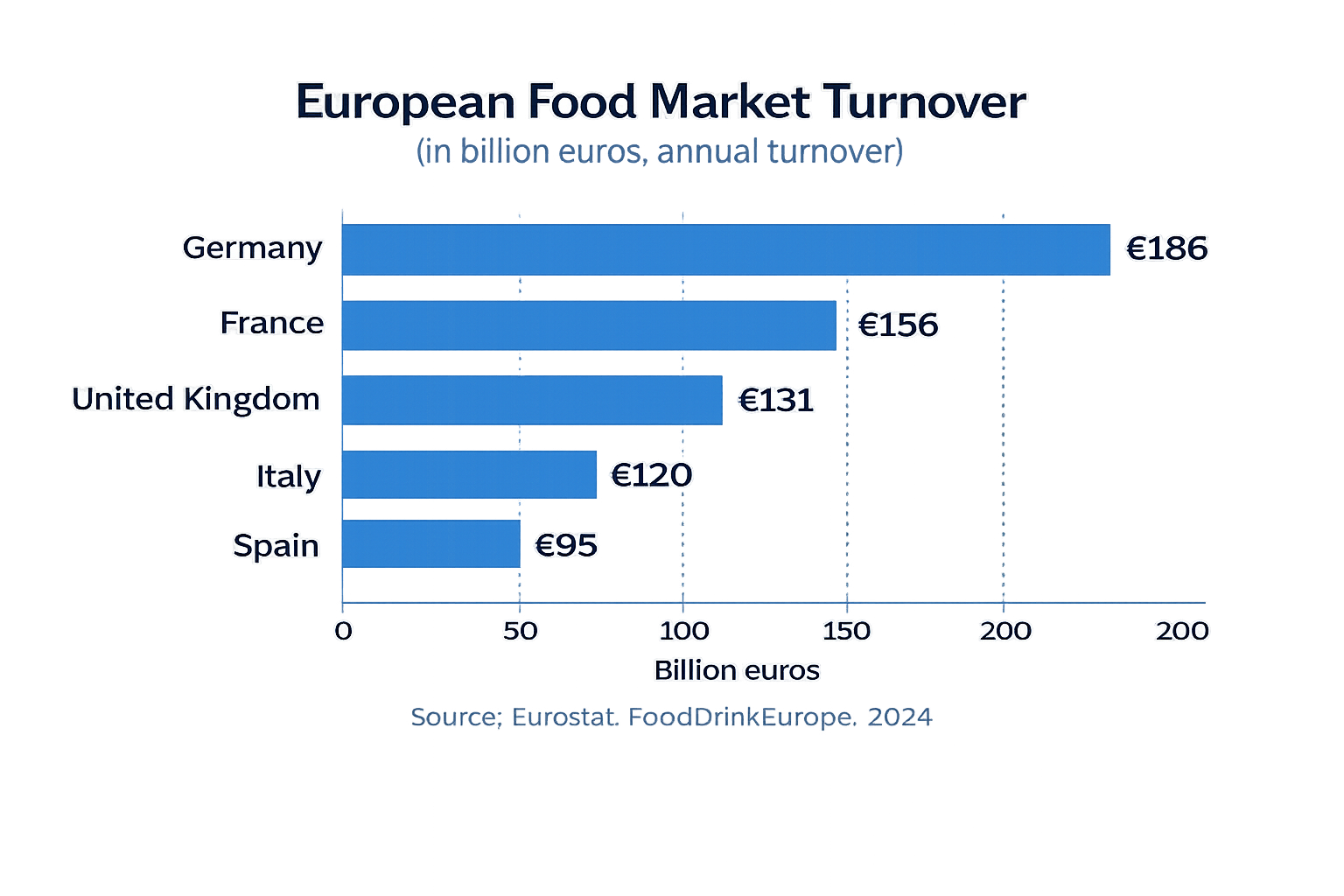
The European market represents 450 million consumers across 27 EU countries. Germany is the largest food market with €186 billion in annual turnover, followed by France with €156 billion and the UK with £131 billion. The premium food import segment is growing at 5-7% annually, creating significant opportunities for international producers.
Germany serves as the ideal entry point for European expansion. With 83 million consumers and strong purchasing power, it offers access to Europe’s largest retail network including REWE, EDEKA, ALDI, and LIDL. Success in Germany provides proof-of-concept before expanding to France, UK, Austria, and other European markets.
Europe: The World’s Largest Premium Food Market
Why Export to Germany First?
Germany represents the largest economy and food market within Europe, generating €186 billion in annual food and beverage sales. With 83 million consumers and the highest purchasing power in Europe, Germany offers the scale needed for profitable market entry.
Beyond its size, Germany serves as the ideal gateway to Europe. Success in the German market provides credibility and proof-of-concept that facilitates expansion into France, Austria, Switzerland, Netherlands, and other European markets. German retail giants REWE, EDEKA, ALDI, and LIDL control 60% of the market and operate throughout Europe.
Strategic Advantages of Starting with Germany:
- Regulatory Gateway: Master German compliance, and you’ve covered 80% of EU requirements. German standards often exceed EU minimums, making expansion to other countries easier.
- Retail Influence: German retailers pilot products domestically before European rollout. A successful REWE listing in Germany often leads to international REWE opportunities (Austria, Czech Republic, Italy).
- Consumer Testing Ground: German consumers are quality-focused, organic-minded, and willing to pay premium prices for superior products. Success here validates your product for all European markets.
- Distribution Network: Germany’s central location and world-class logistics infrastructure make it the optimal hub for reaching neighboring markets efficiently.
- Market Size: At €186 billion, Germany alone offers sufficient market potential to justify investment, unlike smaller European countries where you’d need multi-country expansion from day one.

Product Categories with High Export Potential
The German market shows particularly strong and growing demand for specific international product categories:
From the UK: Whisky and gin (+12% imports annually), sparkling wine, craft beer and cider, premium biscuits, oat cakes and shortbread, artisanal cheese and dairy, marmalades and preserves, tea specialties.
From the USA: Specialty BBQ and hot sauces, premium snacks and protein bars, craft beverages (kombucha, cold brew), maple syrup and honey, peanut butter and nut spreads, gluten-free and keto products.
From Australia: Premium wine (€340M exports to Germany), grass-fed beef and lamb, macadamia nuts and Australian native foods, organic dairy products, manuka honey, plant-based proteins.
From Asia: Authentic soy sauces and condiments, specialty noodles and rice products, Asian snacks and confectionery, matcha and premium teas, fermented foods (kimchi, miso), functional beverages.
In-Depth Guides: Everything You Need to Know
This page provides an overview of exporting food to Europe. For detailed information on specific topics, explore our comprehensive guides below—each aligned with our proven European market entry framework.
1. MARKET ENTRY – European Market Entry Strategy
Strategic planning for Germany and European market success
Learn our proven framework for successful European market entry. Discover why 88% of international food brands fail without strategic planning, and how our 4-pillar approach delivers 67% retail listing success versus 12% for ad-hoc export attempts.
What you’ll learn:
- Strategic country selection: Why 78% of clients start with Germany
- Timing and market sequencing strategy (sequential vs. parallel entry)
- Go-to-market model selection: distributor partnership, direct retail, or hybrid approach
- Investment planning and financial modeling: phased investment framework €140,000-€305,000 over 24 months
- Return expectations: break-even timeline (Months 16-22), ROI projections (300-600% by Year 5)
- Case studies: Real timelines, costs, and results from successful market entries
5. MARKET STUDIES – Market Intelligence Services
Data-driven insights for European market success through comprehensive food and beverage market studies
Transform market intelligence into strategic advantage. The global food and beverage market reached $9.44 trillion in 2025, projected to grow to $11.78 trillion by 2031. Success requires comprehensive market studies that reveal consumer behavior, competitive positioning, and emerging opportunities before you invest.
What you’ll learn:
- Business intelligence and food & beverage market studies for Germany, France, UK, Netherlands, and broader European markets
- Consumer research methodologies; Competitive analysis and market positioning; Market sizing and forecasting; Trend analysis and innovation scouting; Case studies and ROI.
2. FOOD RETAIL LISTING – Secrets of European Retail: Building Buyer Relationships
Getting listed in REWE, EDEKA, ALDI, Carrefour, Tesco, and other major European retailers
Learn how to secure listings in Europe’s leading retail chains. Understand listing requirements, fees, timelines, and negotiation strategies that open doors to €186 billion German market and beyond.
What you’ll learn:
- Key account management strategies for European retail
- Requirements for REWE and EDEKA listing (Germany’s top 2 retailers controlling 35% market share)
- Understanding EDEKA’s cooperative structure (7 regional cooperatives, each with separate negotiations)
- Discounter strategies: ALDI and LIDL listing tactics (combined 25% German market share)
- French retail landscape: Carrefour, E.Leclerc, Intermarché listing processes
- UK retail post-Brexit: Tesco, Sainsbury’s, Asda requirements
- Listing fees and promotional budgets: €15,000-€50,000 per chain depending on category
- Distributor matching: How to find specialized food distributors across 7 European countries
- Retail pitch preparation and buyer meeting strategies
6. EU COMPLIANCE / QUALITY MANAGEMENT – Food Safety and Quality Management
Complete certification roadmap for EU compliance, quality management, and food safety standards
Navigate the EU’s comprehensive regulatory framework with expert guidance. From LMIV labeling requirements to IFS/BRC certification, HACCP implementation, Novel Food assessments, and EUDR compliance—understand exactly what your products need before entering European markets.
What you’ll learn:
- LMIV labeling compliance: EU Regulation 1169/2011 mandatory elements, ingredient list precision (descending weight order, E-numbers for additives), allergen declaration standards (14 major allergens highlighted), nutritional information format (per 100g/100ml), origin marking requirements, Nutri-Score calculation (France, Germany, Belgium, Netherlands, Spain), Traffic Light Labeling (UK post-Brexit)
- HACCP food safety systems: EU Regulation 852/2004 requirements, hazard analysis (biological, chemical, physical), Critical Control Points (CCPs) for thermal processing, pH control, metal detection, allergen management, monitoring and verification procedures, why US/UK HACCP often insufficient for EU auditors
- IFS Food & BRC certification: Retailer-mandated certifications required by 89% of major European retailers, IFS Food requirements (Germany, France, Netherlands, Austria, Spain, Italy), BRC requirements (UK, accepted in some EU markets), certification process phases, investment €8,000-€15,000, success rate 94% with expert support vs. 67% industry average.
3. INVESTMENT & COSTS – How Much Does It Cost to Export Food to Europe?
Get realistic budget expectations for your European market entry
Understand the complete investment required for strategic European market entry. This guide breaks down all costs from compliance and certifications through retail listing and ongoing operations, with examples for small, medium, and large brands.
What you’ll learn:
- Year-one budget breakdown by category: compliance (€15,000-€40,000), market validation (€9,000-€18,000), product adaptation (€10,000-€22,000), distribution setup (€23,000-€57,000), retail listing (€37,000-€70,000), marketing (€13,000-€27,000)
- Total investment framework: €90,000-€185,000 (Year 1), €50,000-€120,000 (Year 2)
- Typical distributor margins: 15-30% depending on category and services
- Retail listing fees by retailer: REWE €20,000-€35,000, EDEKA €15,000-€30,000, ALDI €25,000-€50,000, Carrefour €20,000-€40,000
- Timeline from start to profitability: 16-22 months average
- ROI expectations: 300-600% by Year 5 for successful market entries
- Cash flow management: planning for 90-135 day payment cycles
- Case studies with actual investment and revenue data
7. KNOWLEDGE TRANSFER – CLATU Academy: Keynotes, Talks, Webinars, Coaching, Workshops and Training
Expert training and knowledge transfer for the food and beverage industry
Empower your team with specialized training programs designed for food and beverage professionals navigating European markets. From executive keynotes to hands-on workshops, we deliver practical knowledge that accelerates your market entry success.
What you’ll learn:
- Executive keynotes and industry talks: European market trends, strategic market entry frameworks, retail landscape evolution, sustainability and compliance requirements, delivered at industry conferences, trade shows (Anuga, SIAL, ISM), and corporate events
- Webinars and online training: Live and on-demand sessions covering EU compliance essentials, retail listing strategies, distributor management, key account excellence, digital marketing for food brands
- Customized workshops for food companies: Market entry strategy development, competitive positioning exercises, retail pitch preparation, negotiation training for listing fees and terms, crisis management and product recall procedures
- Coaching and consulting programs: One-on-one executive coaching for founders and CEOs entering European markets, sales team coaching for key account management, ongoing advisory retainers for strategic guidance.
4. STRATEGIC COUNTRY SELECTION – Germany as Your European Gateway
Understanding the European retail landscape and strategic entry pathways across core EU markets
Discover why Germany serves as the optimal strategic entry point for 78% of international food brands. Learn how success in Germany provides proof-of-concept, retail credibility, and operational infrastructure that accelerates expansion into France, UK, Netherlands, Austria, and other European markets.
What you’ll learn:
- Why Germany first: Market fundamentals (€186 billion, 83 million consumers), regulatory gateway advantage (German compliance covers 85% of EU requirements), retail concentration (4 retailers control 60%), distribution infrastructure benefits
- Alternative entry points: When to choose France first (premium positioning, French ingredient connections, €13 billion organic market), UK first (post-Brexit considerations, language advantage), Netherlands first (plant-based brands, Rotterdam port access)
- Key players and retail dynamics by country: Germany (REWE, EDEKA, ALDI, LIDL market shares and strategies), France (Carrefour, E.Leclerc, Intermarché), UK (Tesco, Sainsbury’s, Asda post-Brexit), Netherlands (Albert Heijn 35% market dominance)
- Market entry sequencing strategy: Sequential entry roadmap (Germany → Austria → France/Netherlands → UK), parallel entry considerations for well-capitalized brands
- Country Selection Scorecard: 12 weighted criteria for determining optimal entry market
- Growth dynamics and expansion potential from each entry point
8. INDUSTRIES WE WORK FOR – Specialized Consulting Across Food & Beverage Categories
Industry-specific expertise across the full spectrum of food and beverage markets
We work with diverse food and beverage producers across multiple categories, each requiring specialized market knowledge, regulatory expertise, and retail positioning strategies. Our 30+ years of experience spans traditional and emerging food segments.
- Beverages and Wine,
- Bakery Products,
- Plant-Based and Vegan,
- Organic and Health Foods,
- Specialty Foods,
- Snacks and Confectionery,
- Dairy and Alternatives,
- Meat, Poultry, and Seafood,
- Prepared Foods and Meals
What makes us different: Each industry has unique regulatory requirements, retail channel preferences, consumer trends, and competitive dynamics. We don’t offer generic market entry consulting—we deliver category-specific strategies informed by deep knowledge of your exact market segment, including which retailers prioritize your category, which distributors specialize in your products, what certifications matter most, how to position against established competitors, and what price points succeed.
CONTACT
Ready to Enter the European Market?
Schedule a free 30-minute strategy consultation with our market entry specialists. We’ll assess your product, target markets, and develop your optimal entry roadmap. No sales pressure. Just expert guidance based on 30 years of European market entry experience.
Get in touch and see how we can help you
Follow us on LinkedIn

FOOD AND WINE CULTURE Consulting | Part of CLATU Group
30+ years | 500+ projects | Germany, France, UK, Netherlands, Spain
www.clatu.com | www.foodandwineculture.com
Frequently Asked Questions: Food Export to Germany & Europe
1. How long does it take to export food to Europe successfully?
Timeline: 12-18 months from initial planning to first retail listing and profitability.
Breakdown: Compliance and certifications (Months 1-3), product adaptation and packaging (Months 4-6), distributor selection (Months 7-9), retail pitches (Months 10-12), launch and first sales (Months 13-18).
This timeline assumes you start without EU-specific certifications. If you already have IFS/BRC certification, you can reduce the timeline by 3-4 months. Working with experienced consultants like FAWC typically saves 4-6 months compared to navigating the process independently.
2. What certifications do I need to export food to Germany and the EU?
Mandatory: HACCP (Hazard Analysis Critical Control Points) certification is legally required for all food businesses exporting to the EU.
Required for retail listing: IFS Food or BRC certification is required by 89% of major European retailers, including REWE, EDEKA, ALDI, LIDL, Carrefour, and Tesco. Without IFS/BRC, you cannot approach these retailers.
Category-specific: EU Organic certification (if claiming organic), V-Label (for vegan products), Halal certification (for Muslim consumers).
Cost: HACCP (€3,000-€8,000), IFS Food (€5,000-€12,000), EU Organic (€5,000-€15,000 for non-EU producers).
3. How much does it cost to enter the European food market?
Investment range: €50,000-€150,000 for serious market entry into Germany with 2 retail chain listings.
Breakdown: Certifications (€8,000-€20,000), labeling and packaging adaptation (€7,000-€30,000), listing fees for 2 chains (€30,000-€70,000), marketing and sampling (€18,000-€50,000), logistics and first inventory (€15,000-€40,000).
Lower-cost option: €25,000-€50,000 for e-commerce-first approach (Amazon FBA Germany) or organic specialty chains (Bio Company, Alnatura) which have lower/no listing fees.
Timeline to profitability: Typically 18-24 months from initial investment to break-even.
4. Do I need a distributor to export food to Germany and Europe?
For retail access: It depends on the product, the category, and the market-entry strategy.
For many branded food and beverage products, a distributor is not automatically required. With the right positioning and preparation, our focused sales and key account team can establish direct contact with category managers and buyers at leading European retailers such as REWE, EDEKA or Carrefour.
The advantage of a direct retail approach:
Direct access to decision-makers, clearer feedback from the market, faster listing decisions, and often more favourable commercial conditions, as distributor margins can be avoided.
However, working with a distributor can be a sensible and strategic option in certain cases, for example:
- when products require nationwide logistics, field sales, or in-store execution from day one
- when the category is highly fragmented or relationship-driven (e.g. regional specialties, ethnic foods, foodservice-heavy segments)
- when volumes are initially small and operational bundling with an existing portfolio creates efficiency
- when regulatory, warehousing, or cash-flow considerations make an indirect setup more pragmatic in the early phase
In practice, the optimal route to market is rarely ideological. It is a case-by-case decision based on product characteristics, brand ambition, price architecture, and growth objectives. Our role is to design and execute the setup that delivers the strongest commercial leverage – whether through direct retail access, a selected distribution partner, or a hybrid model.
Distributor role: Handles warehousing, logistics, sales force, retailer relationships, invoicing, and local market knowledge.
Margins: Distributors take 15-35% of the retail price, which must be factored into your pricing strategy.
Selection is critical: The right distributor actively sells your products; the wrong one shelves them. Our due diligence process helps you avoid the 40% of distributors who underperform.
Alternative: For e-commerce (Amazon FBA), you don’t need a distributor initially—Amazon handles fulfillment. This can be a testing ground before approaching retail.
5. What are the biggest challenges when exporting food to Europe?
Challenge 1 – Complex regulations: EU food law (LMIV) differs from FDA, FSA (UK), and other systems. Ingredients approved in your home market may be restricted or banned in the EU. Novel Food regulation catches many exporters by surprise (18-36 months approval, €50,000-€200,000).
Challenge 2 – Certification requirements: IFS/BRC certification is non-negotiable for retail access but costs €5,000-€12,000 and takes 3-6 months. Many exporters don’t budget for this.
Challenge 3 – Retail listing fees: REWE, EDEKA, and other chains charge €15,000-€50,000 per SKU for shelf access. These fees are largely non-negotiable for new brands.
Challenge 4 – Finding reliable distributors: 60% of distributors overpromise and underdeliver. Wrong distributor selection wastes 12-18 months and €50,000+ in opportunity cost.
Challenge 5 – Cultural and taste differences: Products successful in the US/UK/Australia may need recipe adaptation for European palates (less sweet, different portion sizes, local flavor preferences).
How we help: Our 30 years of experience helps you navigate these challenges efficiently, saving time and reducing costly mistakes.
