EUROPEAN MARKET ENTRY STRATEGY GERMANY
European Market Entry Strategy for Food & Beverage Companies
Strategic Planning for Germany and European Market Success
Why do 88% of international food brands fail to establish sustainable market presence in Germany and Europe?
The answer isn’t about product quality or market demand. Most failures stem from one critical mistake: entering European markets without a clear strategic framework.
Successful market entry into Germany and Europe requires more than compliance and distribution—it demands a comprehensive strategy that addresses country selection, timing, investment phasing, key account management, and retail positioning. The difference between strategic and ad-hoc market entry is stark: our clients achieve 67% retail listing success with strategic planning versus 12% for companies that approach Europe without a coherent market entry strategy.
As specialized food consultants with 30+ years of European market entry experience, we’ve developed proven frameworks that help international food and beverage companies navigate the complexity of European market entry strategy Food & Beverage. This guide reveals the strategic foundations that separate successful market entry from costly failures.


Strategic Market Entry Beats Ad-Hoc Export Approaches
Many international food producers treat European market entry as extended export:
- ship products,
- find a distributor,
- hope for sales.
This ad-hoc approach rarely succeeds in competitive European markets.
THE STRATEGIC MARKET ENTRY DIFFERENCE:
Ad-hoc export approach:
- Reactive country selection (“Our distributor knows someone in France”)
- No investment planning beyond first shipment
- Generic positioning across all markets
- Distributor-dependent with no direct retailer relationships
- No clear success metrics or exit criteria
- Average time to profitability: 24-36 months (if at all)
- Success rate: 12-18%
Strategic market entry approach:
- Deliberate country sequencing based on data and fit
- Phased investment roadmap with clear milestones
- Market-specific positioning and product adaptation
- Direct key account relationships built from day one
- Defined KPIs, performance tracking, and decision frameworks
- Average time to profitability: 14-20 months
- Success rate: 62-72%
The strategic approach requires more upfront planning but delivers faster returns, higher success rates, and scalable foundations for European expansion.
Key insight: Germany serves as the optimal strategic entry point for 78% of international food brands. Success in Germany provides proof-of-concept, retail credibility, and operational infrastructure that accelerates expansion into France, UK, Netherlands, Austria, and other European markets.

The 4 Pillars of European Market Entry Success
Our market entry framework is built on five interconnected pillars. Each pillar addresses a critical success factor that determines whether your European expansion thrives or stalls.
PILLAR 1: Strategic Country Selection
The decision of where to enter Europe first shapes your entire expansion trajectory.
🇩🇪 Germany as the strategic gateway (78% of clients start here):
Germany offers unique advantages as your European entry point.
Market fundamentals: €186 billion food market (largest in Europe), 83 million consumers, premium pricing tolerance, and 7-8% annual growth in specialty food imports.
Regulatory gateway: Master German compliance and you’ve covered 85% of EU requirements. German food standards often exceed EU minimums, making subsequent expansion to France, Netherlands, or Austria administratively straightforward.
Retail concentration: Four retailers (REWE, EDEKA, ALDI, LIDL) control 60% of the market. Success with these players opens doors across their European networks—REWE operates in 7 countries, ALDI in 11 countries.
Distribution infrastructure: Germany’s central location and world-class logistics make it the natural hub for serving neighboring markets. A warehouse in Cologne or Frankfurt efficiently reaches 250 million European consumers within 24 hours.
Proof-of-concept value: German consumers are quality-focused and willing to try international products. Success in Germany validates your European positioning and provides sales data that strengthens pitches to French, UK, or Dutch retailers.
Alternative entry points (22% of clients):
🇫🇷 France first:
Consider if your product is premium-positioned, has French ingredient connections (truffles, cheese, deli, snacks, specific wine regions), or you’re targeting the organic / health market (€13 billion).
🇬🇧 UK first (post-Brexit):
Advantage if you’re a UK-based producer or your product has strong UK heritage (Scottish whisky, English gin, Welsh lamb). Language advantage and post-Brexit trade deals may favor certain origins.
🇳🇱 Netherlands first:
Optimal for plant-based brands (highest per-capita vegan population in EU) or if you need Rotterdam port access for Asia-origin products.
Decision framework: Use our Country Selection Scorecard to determine your optimal entry market based on 12 weighted criteria: market size, growth rate, competition intensity, regulatory complexity, consumer fit, retail accessibility, distributor availability, listing costs, language barriers, logistics efficiency, expansion potential, and brand heritage alignment.


PILLAR 2: Timing and Market Sequencing Strategy
When you enter matters as much as where you enter.
Sequential entry (recommended for 85% of brands):
Launch in one country, achieve profitability and operational stability, then expand to country two. This approach conserves cash, enables learning before scaling, and concentrates resources for maximum impact.
Typical sequence:
- Months 1-18: Germany market entry and stabilization
- Months 19-24: Assess performance, refine approach
- Months 25-36: Expand to France or Austria (leveraging German success)
- Months 37-48: Add UK or Netherlands
- Year 5+: Pan-European distribution
Parallel entry (suitable for 15% of brands):
Launch in 2-3 countries simultaneously if you have: significant capital (€200,000+ budget), prior European experience, a product with universal appeal (minimal adaptation needed), or strong brand recognition that reduces market education costs.
Parallel entry risks: Diluted resources, inconsistent execution across markets, slower learning curve, and inability to adjust strategy based on initial market feedback.
Seasonal timing considerations:
Food retail has distinct listing cycles. Strategic timing accelerates access:
Q1 (January-March): Retailers finalize annual assortment plans. Best window for non-seasonal products. REWE and EDEKA conduct primary category reviews in February.
Q2 (April-June): Summer product launches (beverages, snacks, BBQ foods). Ideal for seasonal items. Carrefour (France) and Albert Heijn (Netherlands) have spring listing cycles.
Q3 (July-September): Preparation for holiday season. Good for gift items, premium products, and Christmas-oriented foods. UK retailers (Tesco, Sainsbury’s) start Christmas ranging in August.
Q4 (October-December): Limited new listings due to holiday season focus. Avoid unless you’re specifically targeting Christmas assortment. Use this quarter for relationship-building and preparation for Q1 pitches.
Trade show synchronization: Align market entry with major European food shows. Anuga (Cologne, October, every 2 years) is the world’s largest food fair—German retail buyers attend in force. SIAL Paris (October, alternating years) for French market. ISM Cologne (February) for confectionery and snacks.
PILLAR 3: Go-to-Market Model Selection
How you enter determines your market control, profitability, and scalability.
Here are three primary models for Germany and European market entry:
Model A: Distributor Partnership (recommended for 70% of brands)
How you enter determines your market control, profitability, and scalability. Here are three primary models for Germany and European market entry:
Model A: Distributor Partnership (recommended for 70% of brands)
How it works: Partner with established food distributor who handles warehousing, logistics, sales force, retailer relationships, and market knowledge.
Best for: International brands without European presence, first-time market entrants, products requiring cold chain logistics, or brands with limited capital for direct operations.
Distributor margins: 15-30% of retail price depending on services provided, category, and competitive intensity.
Control level: Medium. You set brand strategy and pricing guidance, but distributor controls day-to-day retail relationships.
Investment required: €50,000-€100,000 (Year 1) for market entry through distributor model.
Key success factors: Rigorous distributor selection (we maintain relationships with 50+ vetted distributors across Germany, France, UK, Netherlands), clear contractual terms on exclusivity and performance minimums, regular joint business planning, and balanced power dynamic (avoid over-dependence).
Germany-specific consideration: German distributors often have regional rather than national coverage due to EDEKA’s cooperative structure. A distributor strong in Southern Germany (Bayern, Baden-Württemberg) may be weak in Northern Germany (Hamburg, Berlin). Plan for potential multiple distributor relationships or select national players like Transgourmet, Chefs Culinar, or category specialists.
Model B: Direct Retail Relationships (suitable for 15% of brands)
How it works: Your company directly manages retailer relationships, warehousing, logistics, and sales without distributor intermediary.
Best for: Large brands with European ambitions and resources, companies with European subsidiary or office, products with high margins that justify direct infrastructure, or brands requiring tight control over positioning.
Investment required: €200,000-€400,000 (Year 1) for direct market entry including local entity setup, warehouse contracts, sales team, and compliance infrastructure.
Control level: High. You control all aspects of market strategy, pricing, promotion, and retail relationships.
Profitability: Higher long-term margins (eliminate 15-30% distributor markup) but higher fixed costs.
Germany implementation: Establish German GmbH (€5,000-€12,000 setup, €25,000 minimum capital), hire German-speaking key account manager (€60,000-€85,000 annual salary), secure warehouse space (€8-€15 per pallet per month), and register for VAT.
Complexity warning: German retail, especially EDEKA’s cooperative structure, requires deep local knowledge. Direct entry without experienced personnel or consultancy support has 85% failure rate.
Model C: Hybrid Approach (growing trend, 15% of brands)
How it works: Strategic combination of direct and distributor models. Common hybrid: direct relationships with top 2-3 retailers (REWE, EDEKA), distributor handles smaller chains, foodservice, and online channels.
Best for: Brands transitioning from distributor model to direct model, companies with partial European presence seeking to expand, or products with distinct channel strategies (premium retail direct, foodservice through distributor).
Investment required: €120,000-€250,000 (Year 1) moderate approach between full distributor and full direct models.
Germany application: Many successful international brands start with distributor for market entry, then transition to direct relationships with REWE and EDEKA once they achieve critical volume (typically €2-3 million annual sales in Germany). Distributor continues serving smaller retailers, organic chains, and foodservice.
Risk management: Requires clear delineation of responsibilities to avoid channel conflict. Contract terms must address transition scenarios.
Pillar 4: Investment Planning and Financial Modeling
European market entry requires strategic capital allocation across a 24-36 month horizon.
Phased investment framework for Germany market entry:
Phase 1 – Foundation (Months 1-6): €40,000-€75,000
Market Research & Strategy:
- Market sizing and opportunity assessment: €3,000-€5,000
- Consumer insights and trend analysis: €3,000-€6,000
- Strategic market entry roadmap: €4,000-€6,000
Compliance and certifications:
- HACCP certification: €3,000-€8,000
- IFS Food or BRC certification: €5,000-€12,000
- EU Organic (if applicable): €5,000-€15,000
- Labeling compliance review and adaptation: €2,000-€5,000
Market validation:
- Consumer taste tests in Germany (50 participants): €4,000-€8,000
- Competitive analysis and retail audits: €3,000-€6,000
- Distributor search and due diligence: €2,000-€4,000
Product adaptation:
- German-language packaging design: €2,000-€5,000
- Nutri-Score calculation and integration: €800-€2,000
- Minimum order packaging production: €5,000-€15,000
*Investment figures represent comprehensive market entry programs.
We offer tailored engagement models including phased implementation, fixed-price packages, and retainer agreements to match your budget and timeline. Contact us for a customized proposal.
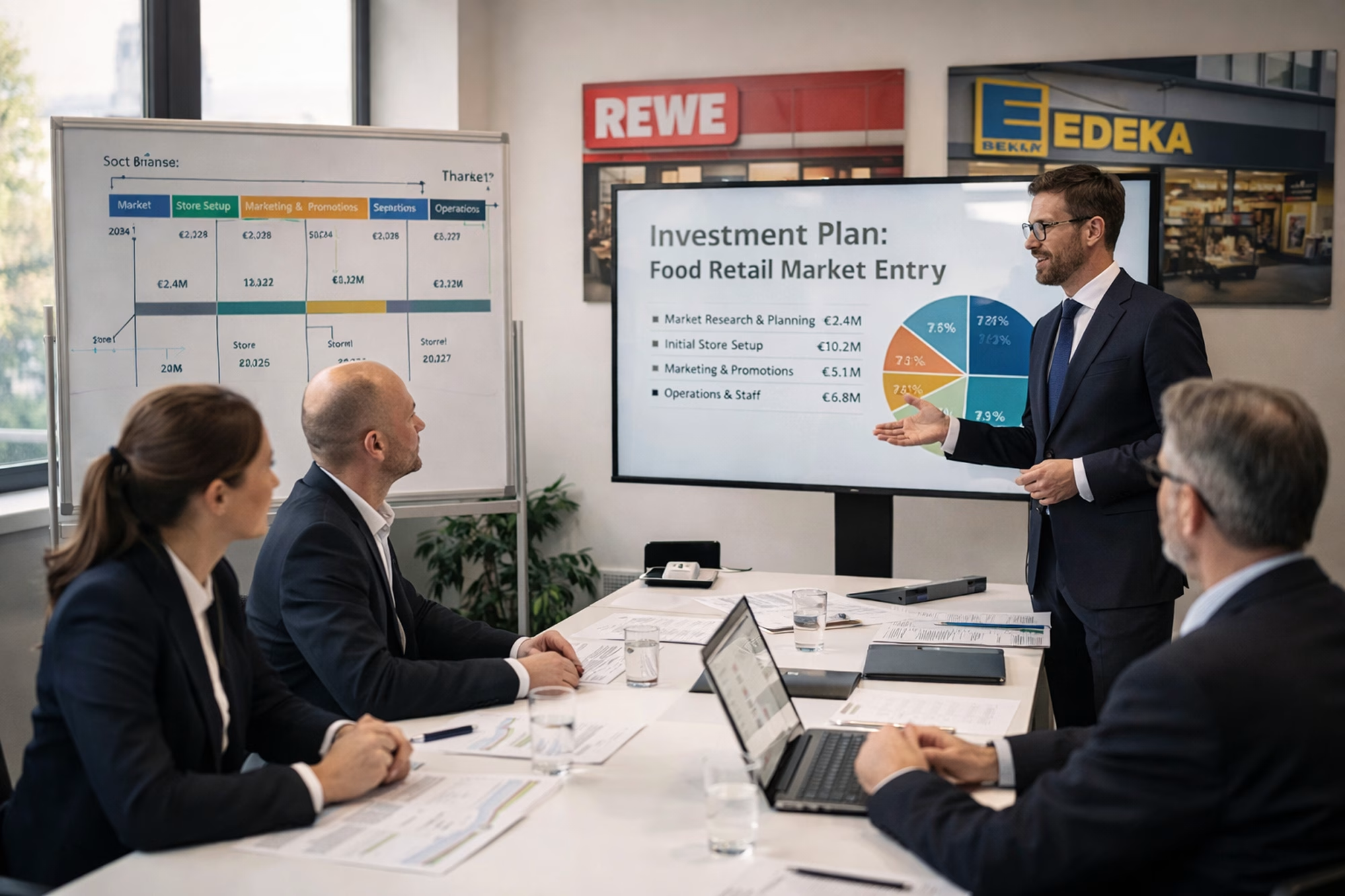
Phase 2 – Market Entry (Months 7-12): €40,000-€90,000
Distribution setup:
- Distributor agreement and initial inventory: €10,000-€25,000
- Warehouse setup and first shipments: €8,000-€20,000
- Logistics and customs (first 3 months): €5,000-€12,000
Retail listing (target: 1-2 chains):
- REWE listing fees (1 SKU): €20,000-€35,000
- EDEKA cooperative listing: €15,000-€30,000
- Retail pitch materials and samples: €2,000-€5,000
Initial marketing:
- In-store sampling campaign (8-12 stores, 4 weeks): €8,000-€15,000
- Trade show participation (e.g., Anuga): €5,000-€12,000
Phase 3 – Growth and Expansion (Months 13-24): €50,000-€120,000
Scaling in Germany:
- Additional retail listings (ALDI or LIDL): €25,000-€50,000
- Expanded distribution (more EDEKA cooperatives): €10,000-€25,000
- Marketing support and promotions: €15,000-€35,000
- Inventory growth and working capital: €20,000-€40,000
Geographic expansion preparation:
- Austria market entry (leveraging Germany setup): €15,000-€30,000
- France or Netherlands market assessment: €5,000-€10,000
Contingency Reserve: €10,000-€20,000
Recommended 8-12% buffer for unforeseen expenses throughout market entry:
legal consultations, tax advisory, additional certifications, customs challenges, or market-specific product adaptations.
Total investment summary for strategic Germany market entry:
Year 1: €90,000-€185,000
Year 2: €50,000-€120,000
Total 24 months: €140,000-€305,000
Return expectations:
- Break-even: Months 16-22 (depending on category margins)
- Profitability: Year 3 onwards
- 5-year cumulative revenue: €1.5M-€4M (successful market entry)
- ROI: 300-600% by Year 5 (market entry investment vs. profit generated)
Cash flow management: Plan for negative cash flow in Months 1-16. Distributor payment terms (60-90 days) plus retailer payment terms to distributor (30-45 days) create 90-135 day cash cycles. Budget working capital accordingly.
Why CLATU vs. Other Consultancies or DIY Approach
Specialized expertise: Unlike Big 4 consultancies that dabble in food or generalist export consultants, we focus exclusively on food and beverage market entry in Europe. We know which REWE category manager handles your product category, what Nutri-Score your competitor products have, and which distributors are actively seeking brands right now.
Established relationships: 30 years of working with European retailers and distributors means we secure buyer meetings in 4-8 weeks vs. 6-12 months independently. Our introductions carry credibility that cold emails never achieve.
Proven methodology: 500+ successful market entry projects have refined our approach. We know what works, what fails, and why. We’ve seen every possible mistake and developed systems to avoid them.
Hands-on implementation: We don’t just deliver strategy PowerPoint presentations and disappear. We work alongside your team throughout implementation—attending distributor meetings, negotiating with buyers, troubleshooting operational issues, and adjusting strategy based on market feedback.
Results orientation: We succeed when you succeed. Our reputation depends on your listings, your sales, and your profitability. We’re incentivized to deliver real results, not impressive-looking reports.
Track record:
- 67% retail listing success rate (vs. 12% industry average without support)
- Average 6-month faster market access (vs. DIY approaches)
- 15-25% better listing fee terms through negotiation expertise
- €1.2B+ in cumulative client revenue generated from European market entry
- 94% client satisfaction rate (ongoing relationships, not one-off projects)


How may we support you?
Choose your preferred contact method — we look forward to the conversation.
* Digital Telephone Assistant
If our consultants are not available to take your call in person, an english-speaking digital AI assistant will take your enquiry and respond in natural language, so we can get back to you promptly.
Follow us on LinkedIn

FOOD AND WINE CULTURE Consulting | Part of CLATU Group
30+ years | 500+ projects | Germany, France, UK, Netherlands, Spain
www.clatu.com | www.foodandwineculture.com
FAQ: European Market Entry Strategy
1. Should I enter Germany or France first?
Germany for 78% of brands. Germany offers larger market size (€186B vs. France €156B), more concentrated retail (75% controlled by 4 retailers vs. France 65% by 5 retailers), serves as regulatory gateway (German compliance covers 85% of EU requirements), and provides better expansion foundation (Germany success facilitates Austria, Netherlands, Switzerland entry).
France first only if: Your product has French ingredient provenance (truffles, Provence herbs, Champagne region), ultra-premium positioning (French consumers pay highest prices in Europe), or you have French-speaking team/subsidiary. French “Made in France” preference makes import positioning challenging.
UK consideration: Treat UK as separate from EU post-Brexit. No longer gateway to Europe. Enter UK if you’re UK-based (minimize complexity) or have strong British heritage (Scotch whisky, English gin).
2. What’s the difference between market entry strategy and export planning?
Export planning focuses on logistics: compliance, certifications, customs procedures, shipping. It answers “Can I legally ship products to Europe?”
Market entry strategy focuses on success: country selection, distributor partnerships, retail positioning, investment phasing, performance metrics. It answers “How do I build sustainable, profitable business in Europe?”
Most exporters focus too heavily on the operational export side and under-invest in strategic market entry side. This leads to products sitting in warehouses or minimal distribution because no one thought about “Who will buy? Which retailers? What positioning? What investment is required?”
Our focus: Strategic market entry. We assume you can handle export logistics (or we can recommend partners) but invest 80% of effort on the strategic and commercial aspects that determine success or failure.
3. How long until profitability in European markets?
Realistic expectation: 16-22 months from initial investment to profitability.
Breakdown:
- Months 1-6: Foundation (compliance, certifications, distributor selection) – Negative cash flow, no revenue
- Months 7-12: Launch (first listings, initial sales) – Revenue starting, cash flow still negative
- Months 13-18: Growth (expanding distribution, optimizing) – Revenue growing, approaching break-even
- Months 19-24: Profitability (operations stable, margins improving) – Positive cash flow achieved
Variables affecting timeline:
- Category margins (premium products break even faster due to higher gross margins)
- Listing success (REWE listing Month 8 vs. Month 14 shifts timeline significantly)
- Investment level (adequate funding accelerates vs. underfunded approaches that drag)
- Market conditions (entering growing category vs. saturated category)
Companies that achieve profitability faster (12-16 months): Already have European IFS certification, language adapted packaging, require minimal product adaptation, secure retail listings quickly (Months 6-8), and invest adequately in marketing support.
Companies that take longer (24-30 months): Underestimate investment requirements, struggle with certifications or compliance, experience distributor challenges, or launch in highly competitive categories with high marketing costs.
4. Can I manage European market entry without hiring consultants?
Yes, but success rate drops from 67% to 12%.
DIY approach works if you have:
- Prior European market experience (you’ve successfully entered European markets before)
- German-speaking team members (or French/Dutch for those markets)
- Sufficient time (founder/CEO can dedicate 20+ hours weekly for 18 months)
- High risk tolerance (comfortable with 80%+ probability of delays, mistakes, or failure)
- Deep pockets (budget for learning curve mistakes that consultants help you avoid)
Consultant support recommended if:
- First-time entering Europe (learning curve is steep and expensive)
- No language skills or cultural knowledge (German business norms differ from US/UK/Australia)
- Limited founder time (you’re running your core business, can’t dedicate to European learning)
- Capital efficiency matters (consultant fees typically saved 3-5x through avoided mistakes, faster market access, better negotiated terms)
Hybrid approach: Many clients engage us for specific phases (e.g., distributor selection, retail listing support) but handle other aspects internally. This reduces cost vs. full-service engagement while de-risking critical success factors.
5. What happens if market entry fails? Can I pivot or should I exit?
Strategic market entry includes defined decision frameworks to determine pivot vs. exit.
Yellow light scenarios (pivot, don’t exit):
- Wrong retailer targeting (approached ALDI but product too premium; pivot to REWE/EDEKA)
- Wrong distributor (poor performance but market opportunity valid; replace distributor)
- Pricing issues (too high or too low; adjust and relaunch)
- Marketing insufficient (increase sampling budget, invest in PR)
- Seasonal timing (launched in wrong quarter; wait for better listing cycle)
Red light scenarios (exit, cut losses):
- Fundamental product-market fit failure (German consumers don’t want the product regardless of positioning)
- Regulatory barriers too high (Novel Food approval required, 18-36 months and €100,000+ investment not justified)
- Category too saturated (10+ established competitors, no clear differentiation, price war dynamics)
- Financial runway exhausted (no capital for continued investment, no path to profitability visible)
Pivot examples from our clients:
US hot sauce brand: Failed in France (6 months, €45,000 invested, minimal traction due to category non-existence). Pivoted to Germany where hot sauce category established. Achieved REWE listing within 8 months of pivot, €280,000 Year 1 revenue.
UK dairy brand: Failed in direct distribution model (€90,000 invested, too complex managing logistics and retail relationships). Pivoted to distributor model, secured Tesco listing through distributor’s relationships within 4 months, €420,000 Year 1 revenue.
Exit decision: If after 12 months and €80,000-€120,000 invested, you have zero retail listings, declining distributor interest, and negative consumer feedback, exit is appropriate. Sunk cost fallacy drives many brands to “try just one more thing” for another 12 months, burning an additional €80,000 with same result. Strategic market entry means having exit criteria defined upfront and respecting them.
