EU Market Entry
Key Account Management in European Retail
Food Retail Listing Europe:
Building Buyer Relationships
Understanding the European Retail Landscape
Strategic market entry requires moving beyond transactional distributor relationships to build direct connections with retail decision-makers. Understanding European retail key account management separates successful market entry from perpetual dependence on distributors.
THE REALITY OF EUROPEAN RETAIL BUYING:
Retail buyers are overwhelmed with supplier pitches. REWE category managers see 200-400 new product presentations annually but list only 15-25 new items. Your challenge isn’t just having a good product—it’s cutting through noise and building relationships that give you fair consideration.
Here are five principles for successful key account management in European retail:
1. Lead with data, not enthusiasm
Buyers respond to evidence, not passion. Bring sales data from other markets, consumer research from Germany, and category growth trends. Example: “Our product achieved 76% sell-through in 180 Kroger stores in the US within 8 weeks. Consumer testing in Germany with 50 participants shows 82% purchase intent.”
2. Understand their business, not just your product
Research the retailer’s category strategy before the meeting. Is REWE expanding organic offerings? Is EDEKA Südwest focused on regional products? Position your product as solution to their strategic priorities, not just a SKU they should list.
3. Make their job easier, not harder
Buyers appreciate suppliers who simplify their work: provide shelf-ready packaging, offer marketing co-investment, deliver on-time consistently, respond quickly to questions. Small operational excellence signals build trust that leads to expanded distribution.
4. Think long-term, not transactional
European retail relationships develop slowly but, once established, provide stable foundations. Don’t push for maximum distribution in year one. Accept test programs (50-100 stores), prove performance, then negotiate expansion. Buyers reward patience and performance.
5. Respect cultural and communication differences
German business culture values directness, punctuality, and preparation. French buyers expect relationship-building before business discussions. UK buyers appreciate humor and personality alongside professionalism. Adapt your approach to local norms.
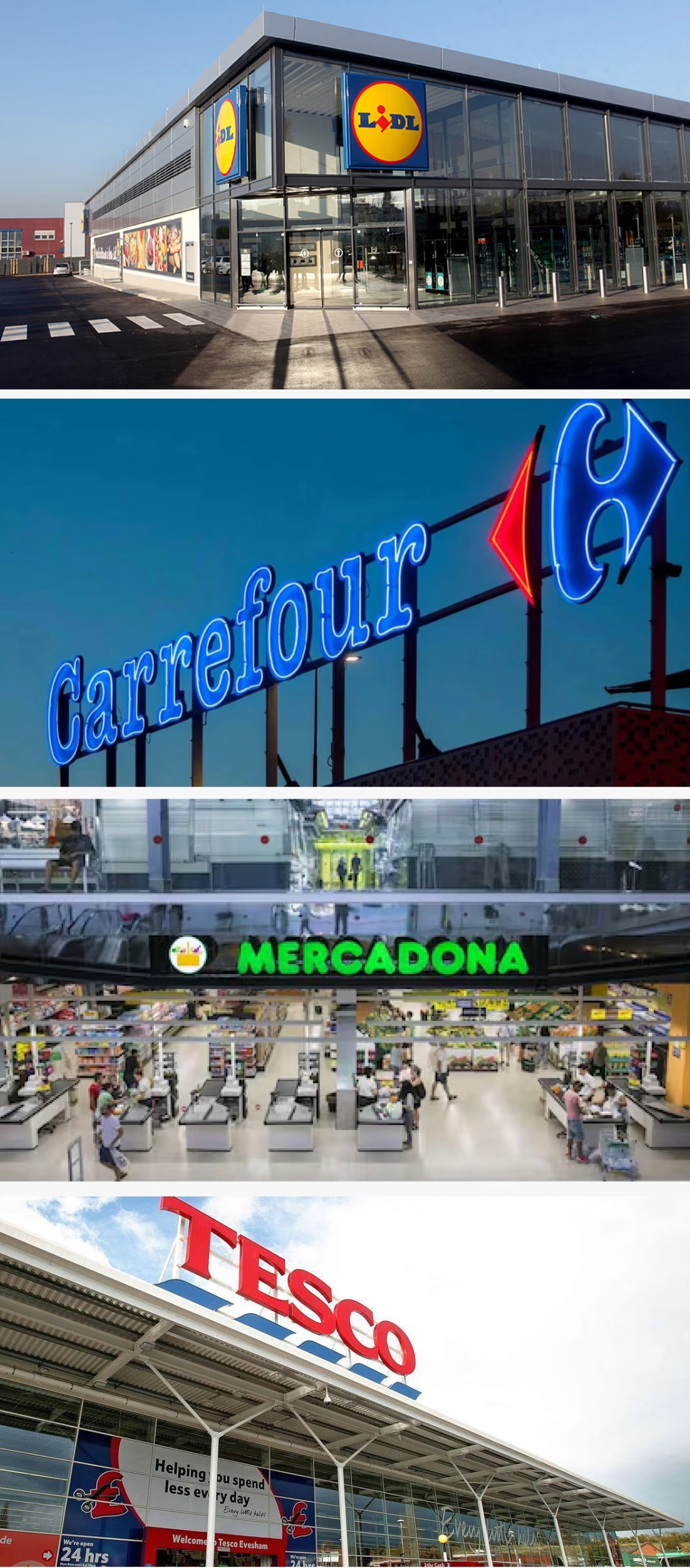
Germany’s Retail Structure:
REWE Group (24% market share, €70B revenue):
- Store formats: REWE supermarkets (3,600 stores), PENNY discount (2,100 stores)
- Centralized buying: Category managers at Cologne headquarters control assortment
- Decision structure: Category Director → Category Manager → Junior Category Manager
- Key account cycle: Annual negotiations (October-December), quarterly reviews
- Innovation openness: High receptivity to premium, organic, and international specialties
- Listing fees: €20,000-€35,000 per SKU depending on category and brand strength
- Negotiation style: Professional, data-driven, relationship matters
EDEKA (20% market share, €58B revenue):
- Cooperative structure: 7 regional cooperatives operate independently
- Decision complexity: Each cooperative makes own assortment decisions
- Regional strategy required: Success with EDEKA Südwest (Stuttgart) doesn’t guarantee EDEKA Nord (Hamburg) listing
- Store formats: EDEKA supermarkets (10,700 stores, mostly independent franchises)
- Key account approach: Regional key account managers, not centralized
- Listing fees: €15,000-€30,000 per SKU, varies by cooperative
- Negotiation style: Relationship-heavy, local presence valued
Schwarz Group – LIDL & Kaufland (19% market share, €105B global revenue):
- LIDL: Discount format, limited assortment (1,700 SKUs vs. 12,000 in REWE)
- Buying: Highly centralized at Neckarsulm headquarters
- Selection criteria: Volume potential, European scalability, price competitiveness
- Listing fees: €25,000-€40,000 (higher than REWE/EDEKA but guaranteed volume)
- Negotiation style: Price-aggressive, data-only, minimal relationship factor
- Timeline: 12-18 months from first contact to shelf (slow, cautious)
ALDI Nord and ALDI Süd (12% combined market share, €53B Germany revenue):
- Two separate companies: ALDI Nord (Northern/Eastern Germany), ALDI Süd (Southern/Western Germany)
- Extreme selectivity: 1,400 SKUs total (most limited assortment in German retail)
- Listing requirements: Must offer clear innovation or price advantage over existing items
- Listing fees: €30,000-€50,000 (highest in Germany, but massive volume if accepted)
- Negotiation style: Price-focused, high pressure, relationship irrelevant
- Advantage: Global reach (ALDI operates in 11 countries, your German listing can lead to international distribution)
Key European Retailers:
France:
Carrefour (Market leader, €32B France revenue):
- European retailer operating in 30+ countries
- Centralized buying at Paris headquarters with regional input
- Strong private label focus (40% of sales) – consider private label route
- Nutri-Score mandatory for prominent placement
- Listing fees: €25,000-€40,000 per SKU
- Key account strategy: Emphasize sustainability, French ingredient connections if possible
E.Leclerc (€42B revenue, cooperative structure like EDEKA):
- 700+ independent store owners make local ranging decisions
- Regional approach required (no centralized “win once” like REWE)
- Strong preference for French products but open to premium imports
- Lower listing fees than Carrefour: €20,000-€35,000
- Relationship-driven, local presence valued
United Kingdom:
Tesco (27% market share, £55B revenue):
- Largest UK grocer, professional buying organization
- Centralized buying at Welwyn Garden City headquarters
- Traffic Light Labeling required (different from Nutri-Score)
- Listing fees: £15,000-£30,000 per SKU
- Post-Brexit complexity: Separate compliance from EU required
Sainsbury’s (15% market share, £30B revenue):
- Quality positioning above Tesco, below Waitrose
- Strong own-brand focus but open to distinctive imports
- Listing fees: £12,000-£28,000
- Negotiation approach: Quality and differentiation emphasized over price
Netherlands:
Albert Heijn (35% market share, €18B revenue):
- Dominant player in Dutch market (Ahold Delhaize group)
- Innovation-focused, early adopter of trends (plant-based, sustainability)
- Test store programs for new products (50-100 stores before national rollout)
- Listing fees: €18,000-€28,000
- Key account advantage: Success here opens door to other Ahold Delhaize banners (Belgium, Central Europe)
The Role of Consultants in Key Account Access:

Why direct cold-calling rarely works:
Retail buyers don’t respond to unsolicited emails or calls from unknown international brands. Gatekeepers filter 90%+ of inbound requests. Without established relationships, your first meeting request may wait 6-12 months.
Strategic consultants provide:
Direct buyer access: We’ve worked with REWE, EDEKA, LIDL, Carrefour, and Tesco category managers for 30 years. Our introductions get meetings scheduled within 4-8 weeks, not 6-12 months.
Pitch preparation: We know what each retailer values, what data they want to see, and which objections to anticipate. We prepare pitch materials tailored to specific buyer preferences.
Negotiation support: We accompany you to buyer meetings, navigate negotiation dynamics, and help secure optimal terms on listing fees, promotional requirements, and payment terms.
Ongoing relationship management: After initial listing, we facilitate quarterly business reviews, address operational issues, and position your brand for expanded distribution as performance proves itself.
Result: Our clients achieve 67% listing success rates vs. 12% for brands approaching retailers independently. The time savings (6-9 months faster market access) and improved terms (15-25% better pricing on listing fees) typically exceed our consulting fees multiple times over.
One honest caveat: Not every product is ready for immediate retail placement. Categories with high saturation – such as olive oils, chocolate bars, or standard fruit juices – face longer evaluation periods or temporary holds, regardless of brand quality or consultant relationships. Similarly, highly exotic or novel ingredients may require regulatory pre-assessment before any buyer conversation begins. Our job is to give you an accurate picture upfront, not false confidence.
Five Critical Market Entry Mistakes to Avoid
Learning from 500+ market entry projects, these mistakes account for 80% of failures:
Mistake 1: Wrong Country Selection Based on Wishful Thinking
The error: “We love France and French food culture, so we should enter France first.”
Why it fails: Personal preference doesn’t equal strategic fit. France may not match your product’s positioning, your budget, or your team’s capabilities.
The strategic approach: Use objective criteria—market size, competitive intensity, consumer fit, regulatory ease, listing costs, distributor availability—to select entry market. Personal preference is one factor among many, not the deciding factor.
Real example: US hot sauce brand insisted on France entry because founder loved Paris. French consumers prefer milder flavors; “hot sauce” category barely exists in French retail. Brand struggled for 18 months, burned €120,000, achieved minimal distribution. Pivoted to Germany where hot sauce category is established, achieved REWE listing within 8 months.
Mistake 2: Underestimating Total Investment Required
The error: “We have €40,000 budget for European market entry.”
Why it fails: Serious market entry in Germany requires €70,000-€150,000 minimum. Insufficient budget leads to cutting corners (skipping IFS certification, minimal marketing, inadequate inventory), which virtually guarantees failure.
The strategic approach: Secure adequate funding before starting. If capital-constrained, consider phased approach (e-commerce first via Amazon FBA to validate market, then retail) or target smaller/organic chains with lower listing fees before approaching REWE/EDEKA.
Real example: Australian beverage brand launched with €45,000 budget. Could afford IFS certification and initial inventory but not listing fees. Distributor secured interest from EDEKA cooperative requiring €28,000 fee. Brand couldn’t pay, lost opportunity, distributor relationship deteriorated. Proper budget planning would have secured funding or targeted different retailers aligned with available resources.
Mistake 3: Poor Distributor Selection (Going with First Option)
The error: “This distributor responded quickly and seems enthusiastic, let’s sign.”
Why it fails: Distributor quality determines 60% of market entry success. Fast response and enthusiasm don’t predict performance. Wrong distributor wastes 12-18 months (contract exclusivity period) and destroys market opportunity.
The strategic approach: Conduct rigorous due diligence. Interview 5-8 distributors, check references with 3-4 retailers they serve, review their existing portfolio (ensure no direct conflicts, verify they’re not spread too thin), and negotiate performance-based contract terms with exit clauses.
Red flags:
- Distributor represents 100+ brands (spread too thin, you won’t get attention)
- Can’t provide verifiable retailer references (claims relationships that don’t exist)
- Promises guaranteed listings (doesn’t control retail decisions)
- Requests upfront fees before securing any business (cash grab)
- Unwilling to share financial statements (hiding instability – 14% of EU distributors failed 2020-2023)
Mistake 4: Launching Without Market Testing
The error: “Our product is successful in the US/UK/Australia, German consumers will love it too.”
Why it fails: Taste preferences, consumption occasions, and product expectations vary dramatically across markets. What sells in the US may fail in Germany due to sweetness levels, portion sizes, flavor profiles, or cultural misalignment.
The strategic approach: Invest €4,000-€8,000 in German consumer testing (50 participants) before finalizing packaging and launching. Test validates market fit, provides data for retail pitches, and identifies needed adaptations (recipe, sizing, messaging).
Real example: US protein bar brand launched in Germany without testing. German consumers found bars too sweet (Americans prefer 18-22g sugar, Germans prefer 8-12g sugar) and portions too large (US 60g bar vs. German preference for 40g bar). Low sell-through in REWE test stores (38% vs. 70% target), delisting after 4 months. €65,000 invested, zero return. Pre-launch testing (€6,000) would have identified issues, enabled reformulation, and prevented failure.
Mistake 5: Attempting Multi-Country Launch Without Foundation
The error: “Let’s launch in Germany, France, and UK simultaneously to maximize growth.”
Why it fails: Resources spread too thin, inconsistent execution across markets, inability to learn and adjust based on initial market feedback, slower path to profitability in all markets.
The strategic approach: Sequential entry for 85% of brands. Master one market (typically Germany), achieve operational stability and profitability, then expand to market two with learnings applied.
When parallel entry works: Only if you have (1) significant capital (€250,000+ budget), (2) prior European experience, (3) product requiring minimal local adaptation, and (4) team capacity to manage multiple markets simultaneously (separate country managers, not one person juggling three markets).
Real example: UK food brand launched Germany, France, and Netherlands simultaneously with €180,000 budget. Each market received €60,000 investment—insufficient for serious market entry in any single market. All three markets underperformed, brand achieved listings in none of the targeted retailers, burned entire budget within 15 months with zero revenue. Sequential approach (€180,000 focused on Germany alone) would have secured REWE listing, achieved profitability, and created foundation for subsequent expansion.






CONTACT
Ready to Enter the European Market?
Schedule a free 30-minute strategy consultation with our market entry specialists. We’ll assess your product, target markets, and develop your optimal entry roadmap. No sales pressure. Just expert guidance based on 30 years of European market entry experience.
Get in touch and see how we can help you
Follow us on LinkedIn

FOOD AND WINE CULTURE Consulting | Part of CLATU Group
30+ years | 500+ projects | Germany, France, UK, Netherlands, Spain
www.clatu.com | www.foodandwineculture.com
Frequently Asked Questions:
European Retail Listings
How do you develop our European Market Entry Strategy?
Strategic market entry requires expertise that most international food brands don’t possess internally.
Our Strategic Market Entry Services
Phase 1: Market Entry Strategy Development (6-8 weeks)
We work with you to create a comprehensive strategic framework:
Market selection and sequencing:
- Evaluate 4-6 potential entry markets using our 12-criteria Country Selection Scorecard
- Recommend optimal entry market and 36-month expansion sequence
- Provide market-specific opportunity assessment (market size, growth rates, competitive landscape)
Go-to-market model design:
- Assess distributor partnership vs. direct model vs. hybrid approach
- Identify specific distributors or direct infrastructure requirements
- Model financial implications of each approach
Investment planning and financial modeling:
- Develop phased investment roadmap (Months 1-6, 7-12, 13-24)
- Build detailed P&L projections by market and quarter
- Identify funding gaps and financing solutions
Performance framework:
- Define KPIs and success metrics for each market entry phase
- Establish decision frameworks (green/yellow/red light criteria)
- Create quarterly review process
Deliverable: 40-60 page Strategic Market Entry Plan with executive summary, detailed market analysis, financial models, and 36-month implementation roadmap.
Phase 2: Market Entry Execution Support (12-18 months)
Strategic planning is valuable, but execution determines success. We guide you through implementation:
Distributor matching and selection:
- Shortlist 5-8 qualified distributors from our network of 50+ vetted partners
- Facilitate distributor meetings and due diligence
- Negotiate contract terms and support agreement finalization
- Ongoing distributor relationship management and performance monitoring
Retail listing coordination:
- Schedule category manager meetings at target retailers (REWE, EDEKA, Carrefour, Tesco)
- Prepare retail pitch materials tailored to each buyer’s preferences
- Accompany you to buyer meetings and support negotiations
- Negotiate optimal listing terms (fees, promotional requirements, payment terms)
Launch support:
- Coordinate test store programs and in-store sampling campaigns
- Monitor launch performance and address issues rapidly
- Facilitate communication between you, distributor, and retailers
- Conduct post-launch analysis and optimization recommendations
Ongoing advisory:
- Quarterly business reviews assessing performance vs. plan
- Strategic guidance on expansion decisions (timing, country selection)
- Problem-solving for operational challenges
- Preparation for annual retailer negotiations
Phase 3: Scaling and Multi-Market Expansion (Months 18-36)
After establishing your foundation market, we support strategic expansion:
Country two entry strategy:
- Apply learnings from first market to accelerate second market entry
- Adapt approach for country-specific requirements (France Nutri-Score, UK Traffic Light Labeling)
- Leverage first market success to strengthen second market pitches
Pan-European infrastructure planning:
- Design hub-and-spoke logistics model
- Evaluate pan-European distributor consolidation opportunities
- Develop transition strategy from local to regional operations
Portfolio expansion:
- Assess opportunities for additional SKUs based on market performance
- Guide new product introductions leveraging existing retail relationships
- Support line extensions and market-specific product adaptations
Why should we choose you vs. other consultancies or a DIY approach?
Specialized expertise: Unlike Big 4 consultancies that dabble in food or generalist export consultants, we focus exclusively on food and beverage market entry in Europe. We know which REWE category manager handles your product category, what Nutri-Score your competitor products have, and which distributors are actively seeking brands right now.
Established relationships: 30 years of working with European retailers and distributors means we secure buyer meetings in 4-8 weeks vs. 6-12 months independently. Our introductions carry credibility that cold emails never achieve.
Proven methodology: 500+ successful market entry projects have refined our approach. We know what works, what fails, and why. We’ve seen every possible mistake and developed systems to avoid them.
Hands-on implementation: We don’t just deliver strategy PowerPoint presentations and disappear. We work alongside your team throughout implementation—attending distributor meetings, negotiating with buyers, troubleshooting operational issues, and adjusting strategy based on market feedback.
Results orientation: We succeed when you succeed. Our reputation depends on your listings, your sales, and your profitability. We’re incentivized to deliver real results, not impressive-looking reports.
Track record:
- 67% retail listing success rate (vs. 12% industry average without support)
- Average 6-month faster market access (vs. DIY approaches)
- 15-25% better listing fee terms through negotiation expertise
- €1.2B+ in cumulative client revenue generated from European market entry
- 94% client satisfaction rate (ongoing relationships, not one-off projects)
