Food & Beverage Market Studies and Strategic Business Intelligence
Food & Beverage Market Studies:
Data-Driven Insights for European Market Success
Transform Market Intelligence
into Strategic Advantage
The global food and beverage market reached $9.44 trillion in 2025 and is projected to grow to $11.78 trillion by 2031, expanding at 3.75% CAGR. Success in this dynamic market requires more than intuition—it demands comprehensive food and beverage market studies that reveal consumer behavior, competitive positioning, and emerging opportunities before you invest.
We deliver strategic business intelligence and specialized food and beverage market studies for international producers entering Germany, France, UK, Netherlands, and broader European markets. Our research combines quantitative data analysis with qualitative consumer insights, providing actionable intelligence that reduces market entry risk and accelerates time-to-revenue.
Why Food & Beverage Market Studies Matter
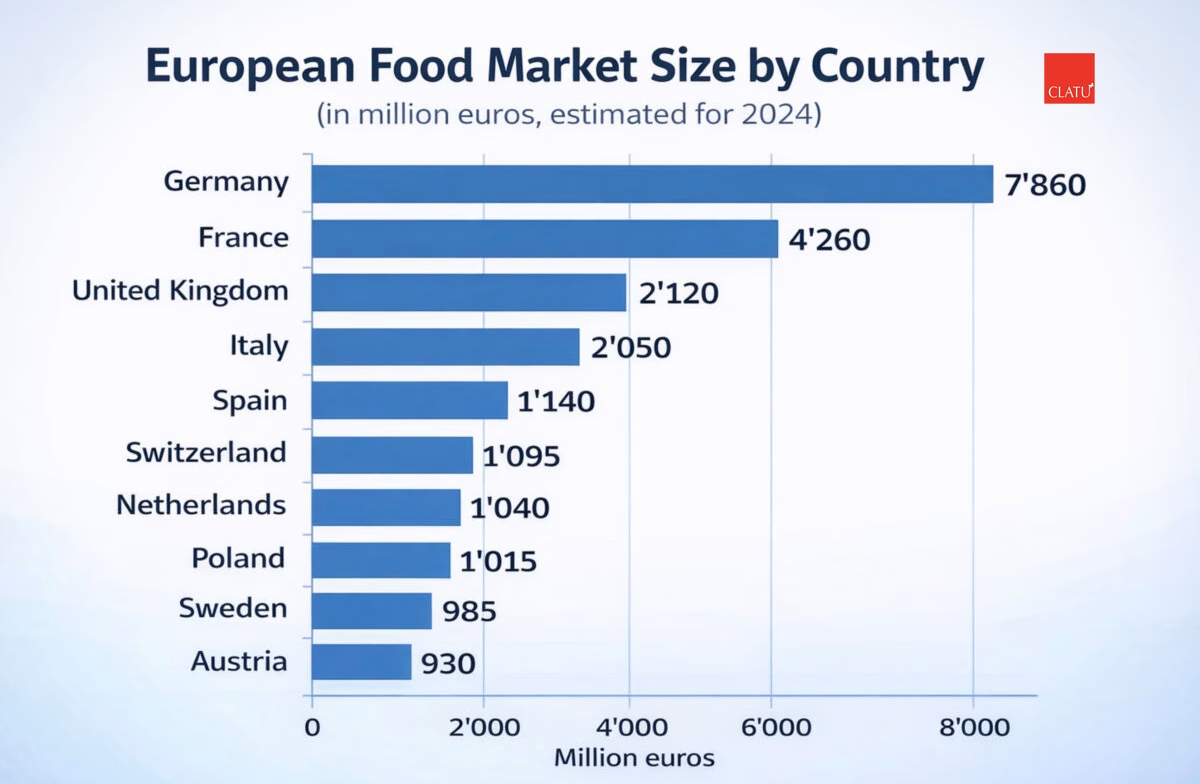
Consumer preferences are shifting toward premiumization, customization, clean label products, and processed foods driven by hectic lifestyles. European consumers increasingly demand products free from GMOs, synthetic ingredients, and allergens—preferring natural and organic options, particularly in Germany (€15.3 billion organic market) and France (€13 billion organic market).
Without market validation, 88% of European market entry attempts fail due to misalignment between product offering and local consumer expectations. Our food and beverage market studies prevent costly mistakes by testing product-market fit before significant investment.
Key Market Dynamics We Research:
- Health and wellness focus driving functional food demand with enhanced nutritional benefits
- Convenience trends: single-serve, ready-to-eat, shelf-stable products gaining share
- E-commerce growth at 5.63% CAGR through 2031, reshaping distribution strategies
- Sustainability and ethical sourcing as purchase drivers (82% of Dutch consumers prioritize sustainability)
- Plant-based and vegan segment expanding at 5.41% CAGR across Europe
- Alcohol moderation trends: declining wine consumption, rising demand for low- and no-alcohol alternatives, and retailer assortment shifts toward premium non-alcoholic beverages
- Foodservice and gastronomy trends: evolving guest expectations in restaurants, hotels, and catering driving menu innovation, ingredient transparency, and experience-focused dining concepts

Our Food & Beverage
Market Studies Services
Consumer Research & Taste Testing
Qualitative Methods: Focus groups (8-12 participants), in-depth interviews (30-50 consumers per market), ethnographic studies observing natural consumption behavior.
Quantitative Methods: Online and offline surveys (300-500 respondents statistically significant samples), CATI (Computer-Assisted Telephone Interviewing), product testing with blind comparisons.
Deliverable: Consumer preference profiles, taste perception analysis, packaging appeal assessment, pricing sensitivity curves, purchase intent scores.
Competitive Analysis & Market Positioning
Market Landscape Mapping: Identify key competitors by category, analyze market share distribution, evaluate competitive pricing strategies, assess promotional tactics and seasonal patterns.
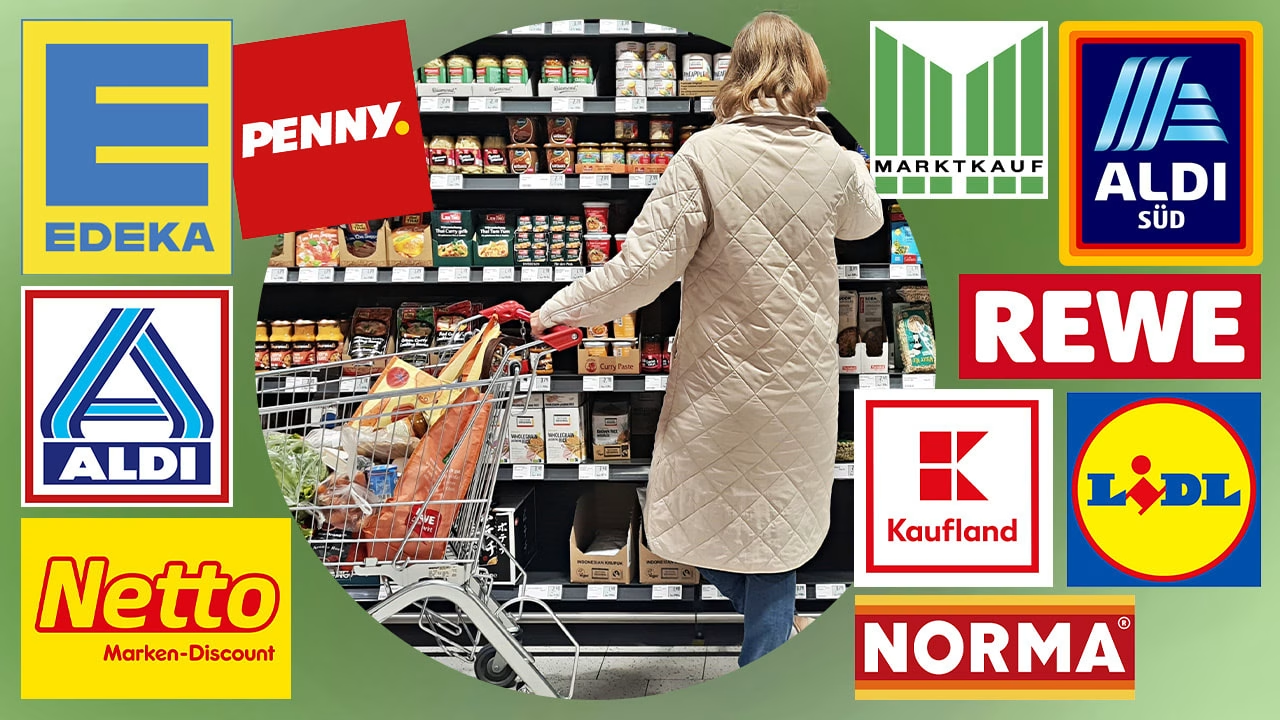
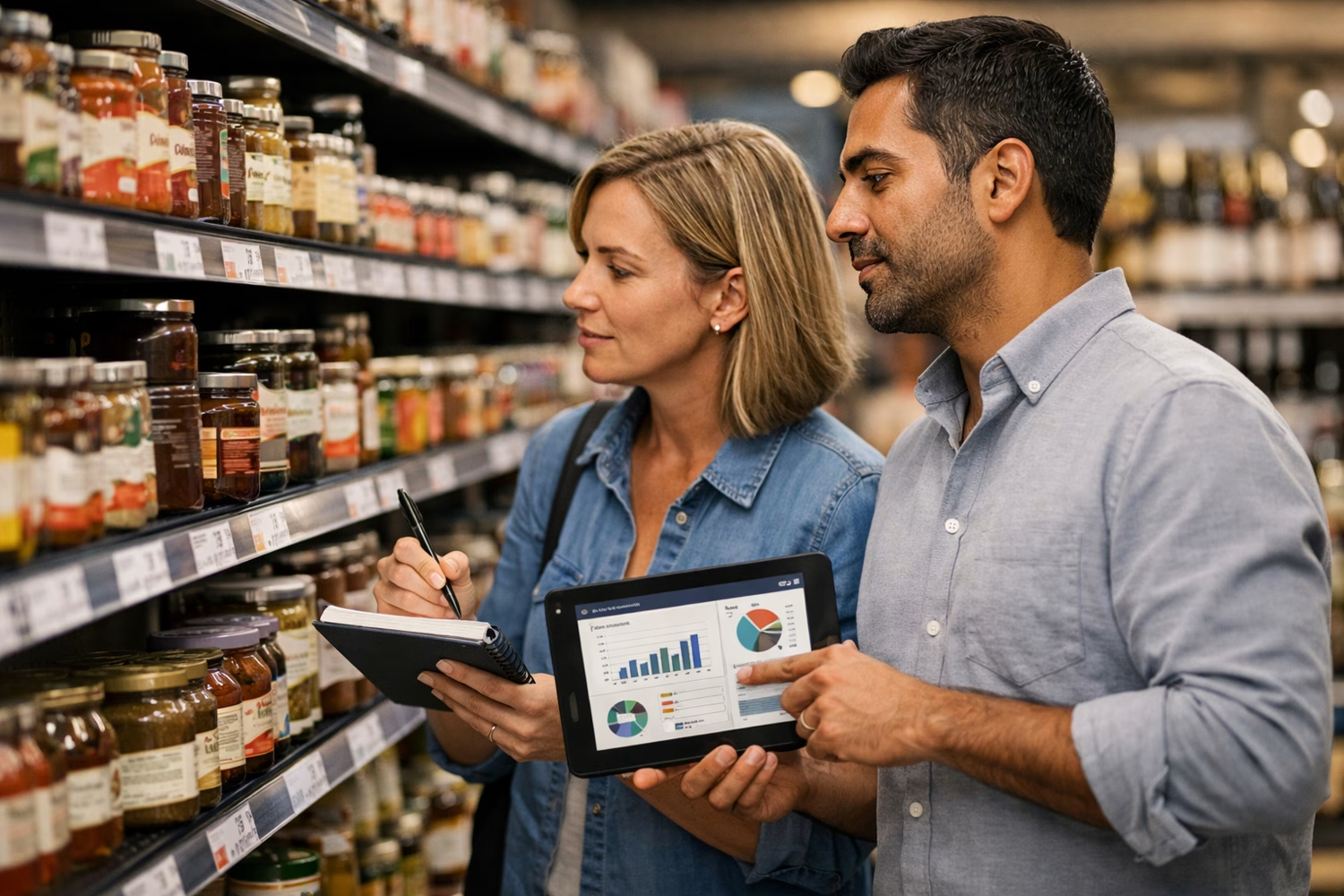
Shelf Audits: Store visits across 20-30 retail locations (REWE, EDEKA, Carrefour, Tesco, Albert Heijn), photograph competitive sets, document shelf placement and facings, measure price points and promotional frequency.
SWOT Analysis: Competitive strengths and weaknesses, market gaps and white space opportunities, threat assessment from established players and new entrants. Plus a GAP Analysis Report, analyzing the space between where your company is today and where it wants to be in the future.
Deliverable: Competitive positioning matrix, differentiation strategy recommendations, pricing corridor analysis, go-to-market positioning statement.
Market Sizing & Forecasting
Top-Down Analysis: Total European food market segmentation by category, distribution channel (supermarkets/hypermarkets 51.10% share), packaging type (plastic 44.92% share), and nature (conventional 70.55%, organic growing at 5.41% CAGR).
Bottom-Up Analysis: Retailer-specific volume projections, distributor capacity assessment, realistic sell-through assumptions based on comparable product performance.
TAM/SAM/SOM Calculation: Total Addressable Market (entire category in target countries), Serviceable Available Market (realistic segment you can access), Serviceable Obtainable Market (achievable first-year share based on budget and distribution).
Deliverable: Market size estimates, 3-year revenue projections, sensitivity analysis (best case, base case, worst case scenarios).
Trend Analysis & Innovation Scouting
We monitor emerging food and beverage trends across European markets: ingredient innovations (tracking GNPD – Global New Products Database), packaging developments (sustainable materials, portion formats), retail channel evolution (quick commerce, specialty e-tailers), regulatory changes (Novel Food approvals, EUDR implementation impacts).
Deliverable: Quarterly trend reports, competitive launch tracking, innovation opportunity identification, regulatory horizon scanning.
Data Validation: Cross-reference primary research with secondary sources (Eurostat, national statistics offices, industry reports), triangulate findings across multiple methodologies, peer review by senior analysts, client review and refinement cycles.
Timeline: 6-10 weeks from project kickoff to final report delivery.
Proven Research Methodologies
Our food and beverage market studies employ rigorous research standards: statistically significant sample sizes (minimum 300 respondents for quantitative studies), balanced demographic representation (age, gender, income, household composition), geographic distribution across urban/suburban/rural markets, psychographic segmentation (health-conscious, convenience-seekers, price-sensitive, premium buyers).
Data Validation: Cross-reference primary research with secondary sources (Eurostat, national statistics offices, industry reports), triangulate findings across multiple methodologies, peer review by senior analysts, client review and refinement cycles.
Timeline: 4-10 weeks from project kickoff to final report delivery.
Investment: €4,000-€15,000 per market depending on sample size and methodology complexity.
Frequently Asked Questions:
Food & Beverage Market Studies
1. Why conduct food and beverage market studies before entering Europe?
Without market validation, 88% of European market entry attempts fail due to product-market misalignment.
Food and beverage market studies prevent costly mistakes by testing critical assumptions before you invest €50,000-€150,000 in market entry. Our research validates five key questions: Does your product meet local taste preferences? (German consumers prefer less sweet; French consumers prioritize premium positioning). What price point maximizes market acceptance? (Price sensitivity varies dramatically: premium organic in Germany vs. value-conscious mainstream in Poland). Which competitors will you displace? (Shelf space is zero-sum—success requires displacing existing products). What marketing messages resonate? (Health claims, sustainability credentials, convenience benefits perform differently by market). Which distribution channels offer fastest access? (E-commerce vs. retail vs. foodservice entry strategies).
Investment protection: Market studies cost €4,000-€25,000. Compare this to launching a misaligned product: €30,000 listing fees + €20,000 packaging + €15,000 certifications + €25,000 inventory = €90,000 lost if product fails due to preventable market misfit.
Timeline advantage: 4-10 weeks of research prevent 12-18 months of misguided market entry effort.
2. What’s included in your food and beverage market studies?
Our research delivers actionable go/no-go recommendations, not generic reports.
Consumer Research Component: Qualitative insights through focus groups (8-12 participants) and in-depth interviews (30-50 consumers per market), quantitative validation via surveys (300-500 respondents statistically significant), product taste testing with blind comparisons against competitive benchmarks, packaging appeal assessment and messaging testing, pricing sensitivity analysis (Van Westendorp Price Sensitivity Meter), purchase intent scoring and conversion likelihood.
Competitive Analysis Component: Shelf audits across 20-30 retail locations (REWE, EDEKA, Carrefour, Tesco, Albert Heijn), competitive pricing documentation and promotional frequency tracking, market share estimation by category and segment, SWOT analysis identifying white space opportunities, positioning matrix showing differentiation pathways.
Market Sizing Component: Total Addressable Market calculation (entire category in target countries), Serviceable Available Market assessment (realistic segment accessible with your positioning), Serviceable Obtainable Market projection (achievable first-year share based on budget and distribution), 3-year revenue forecasting with sensitivity analysis (best case, base case, worst case scenarios).
Deliverables: Executive summary with clear go/no-go recommendation, detailed research findings, competitive positioning strategy, pricing corridor recommendations, distribution channel prioritization, marketing message testing results, appendix with raw data and methodology documentation.
Timeline: 4-10 weeks from project kickoff to final presentation.
3. How much do food and beverage market studies cost?
Investment range: €4,000-€25,000 depending on scope and geographic coverage.
Single-market consumer research (Germany only): €4,000-€10,000. Includes qualitative research, quantitative survey, taste testing, competitive shelf audit / mystery shopping.
Multi-market competitive analysis (Germany + France + UK): €8,000-€18,000. Includes shelf audits across country stores, pricing and promotional tracking, market share estimation, positioning matrix development, white space opportunity identification.
Comprehensive market entry study (single country, all research components): €10,000-€25,000. Includes consumer research (qualitative + quantitative), competitive analysis (shelf audits, SWOT), market sizing (TAM/SAM/SOM), 3-year revenue forecasting, go-to-market strategy recommendations.
ROI perspective: Market studies represent 15-20% of total market entry investment (€50,000-€150,000) but prevent 80-90% of preventable failures. Research validates or invalidates assumptions that determine success or failure of entire market entry program.
Comparison: Market studies (€15,000) vs. cost of failed launch without research (€90,000 sunk costs in listing fees, packaging, certifications, inventory + 12-18 months lost time + damaged retailer relationships). The €15,000 investment protects €90,000+ at risk.
Payment structure:
For Germany-based clients: 50% upon project kickoff, 50% upon delivery of final report.
For international clients: Prepayment / Invoices are issued in advance and payable upon receipt to ensure seamless project delivery across borders.
How may we support you?
Choose your preferred contact method — we look forward to the conversation.
* Digital Telephone Assistant
If our consultants are not available to take your call in person, an english-speaking digital AI assistant will take your enquiry and respond in natural language, so we can get back to you promptly.
Follow us on LinkedIn

FOOD AND WINE CULTURE Consulting | Part of CLATU Group
30+ years | 500+ projects | Germany, France, UK, Netherlands, Spain
www.clatu.com | www.foodandwineculture.com
